
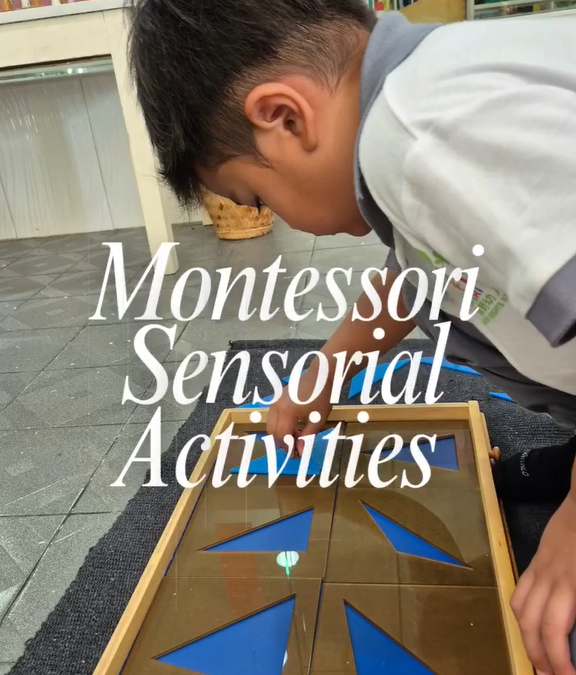
Ever wonder why Montessori classrooms are filled with beautiful wooden towers, smelling jars, and fabric swatches? It’s not just for aesthetics—it’s brain building in action.
In the Montessori world, we call the child a “sensorial explorer.” Between the ages of 3 and 6, children are in a sensitive period for refining their senses. They aren’t just looking at the world; they are categorizing it.
What’s Happening Behind the Scenes?
The Pink Tower: It’s more than stacking blocks. It’s a physical lesson in dimensionality and volume.
The Color Tablets: We’re moving beyond “red” and “blue” to discern the tiniest gradients of shade, sharpening visual discrimination.
The Mystery Bag: By feeling objects without looking, children develop stereognostic sense—the ability to recognize an object using only tactile information.
The Goal?
To give the child a “key to the universe.” By isolating qualities like weight, texture, sound, and scent, we help them organize the thousands of stimuli they encounter every day.
When a child masters a sensorial work, they aren’t just “playing”—they are developing the mathematical mind and the focus required for a lifetime of learning.
#Montessori#SensorialLearning#FollowTheChild#EarlyChildhoodEducation
#preschoolearlychildhoodeducation