In Montessori education, the purpose of a child’s work is to support their self-construction helping them develop independence, concentration, coordination, and confidence through meaningful, hands-on activities. Practical Life exercises such as pouring, cleaning, or buttoning are not just tasks, but opportunities for children to grow in body, mind, and spirit.
Unlike adults, who typically work to achieve results or complete goals, children work for the sake of development. Their focus is on the process, not the product. Through repetition and purposeful movement, Montessori children find joy in doing, learning to care for themselves and their environment while building the foundation of who they are becoming.
In the Montessori classroom, children explore language through movement, touch, and meaningful use. They handle letters, build words, and begin to write naturally—connecting their inner thoughts with the outer world. By doing so, they are not only learning a skill, they are participating in one of humanity’s most important traditions: the sharing of ideas through written symbols.
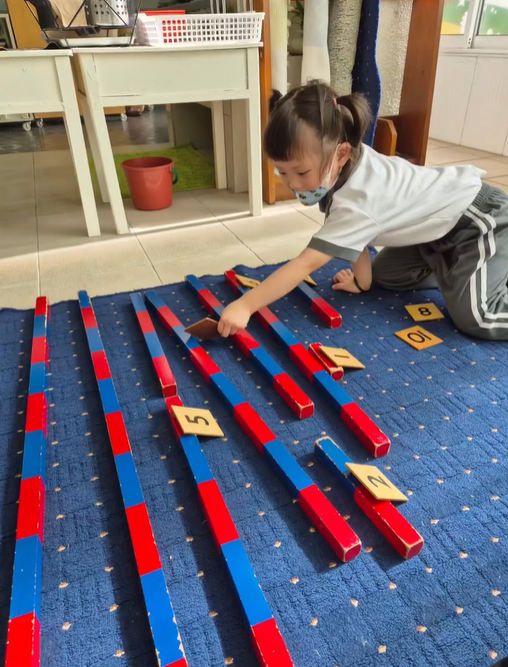
“At four years old, the children began composing numbers up to a thousand. As they continued to grow, their progress was truly remarkable—by the age of six, many were confidently performing all four operations with numbers up to the millions. Their journey reflects not only academic achievement but also a deep, joyful engagement with learning.”
In the early stages of Montessori mathematics, children work with physical objects that represent mathematical concepts. These materials are designed to engage the child’s senses and allow them to explore math in a tangible, interactive way.
Through concrete materials, children experience mathematical concepts in a real-world, hands-on way, which helps solidify their understanding.
After the child becomes familiar with the concrete materials, they move to semi-concrete representations. This is the stage where children begin using symbols or pictures to represent the concrete materials they worked with earlier.
Once the child has a deep, intuitive understanding of mathematical concepts through concrete and semi-concrete experiences, they are ready to understand the abstract symbols and operations used in formal mathematics.
This progression from concrete to abstract ensures that children build a solid foundation of understanding before moving to more complex, symbolic math.
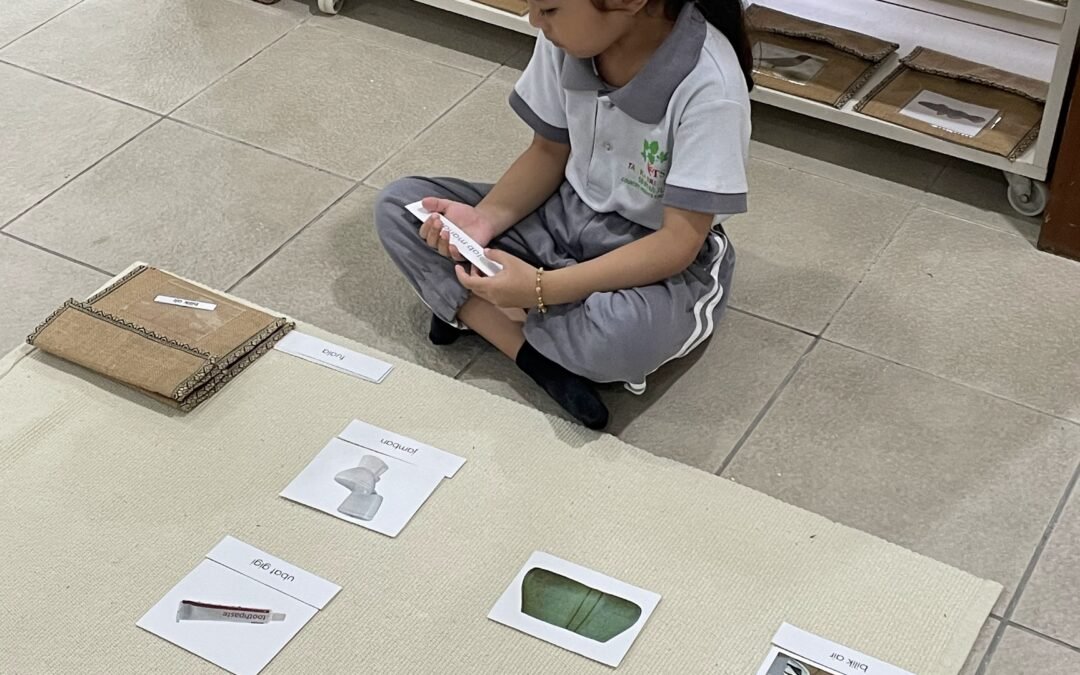
In Montessori, every picture is more than just an image it’s a gateway to understanding, curiosity, and wonder.
These classified cards are not just tools; they are stepping stones that help little minds connect with the beauty and diversity of the world around them.
Each matching moment is a triumph, each discovery a spark of joy.
Here, learning is not just about knowledge it’s about nurturing confidence, independence, and a lifelong love for exploration.