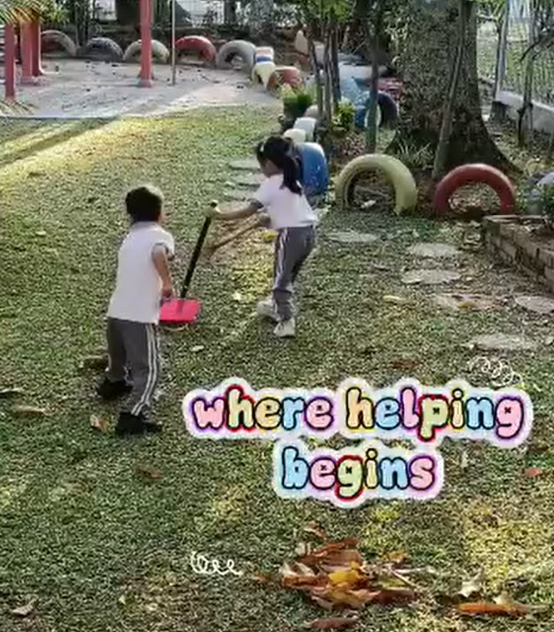
One of the most heartwarming aspects of a Montessori classroom is seeing how naturally children care for and support one another.
In a mixed-age environment, learning isn’t just about individual growth—it’s about building friendships, sharing experiences, and growing together.
Older children gently guide, younger ones learn through observation, and every child finds their place in a caring community.
For parents, it’s a beautiful reminder that learning goes beyond academics—your child is also developing empathy, confidence, and a genuine sense of kindness every day.
Our little explorers (ages 3–6) swapped the classroom for the stables today, and what a *magical* morning it was!
From the moment we arrived, the air was filled with excitement and a few happy “neighs.” Our students got hands-on experience learning about these gentle giants. Here’s a peek into our day:
Grooming: We learned how to use soft brushes to make the horses’ coats shine.
Feeding: Our brave adventurers practiced their “flat hands” to feed crunchy carrots and apples.
Riding: The highlight of the trip! Seeing the confidence grow on every child’s face as they took their first pony ride was priceless.
To wrap up our big day, we headed over to the Equestrian Cafe. The children enjoyed a sumptuous lunch while watching the horses train on the racing field right outside our window. Talk about a “room with a view!”
We are so proud of how brave, respectful, and curious our little learners were today. Thank you to the wonderful staff for hosting us and teaching us all about equine care!
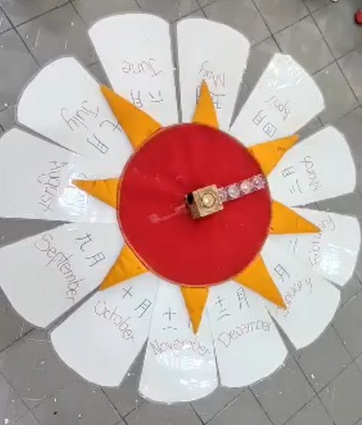
In the Montessori “Walking Around the Sun” birthday celebration, the child typically walks anti-clockwise.
Why counterclockwise?
It reflects the real movement of the Earth around the Sun when viewed from above the North Pole. In astronomy, the Earth and most planets orbit the Sun in a counterclockwise direction. Representing this direction helps keep the activity aligned with Montessori’s idea of connecting the child to real cosmic order.
This also fits with the philosophy introduced by Maria Montessori in Cosmic Education, where children learn about their place in the universe through accurate, concrete experiences.
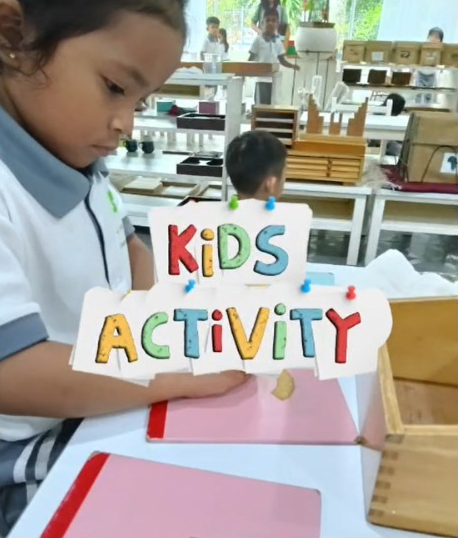
Words are coming alive in our Montessori classroom.
Through hands-on language activities, children are naturally building their vocabulary, refining their pronunciation, and growing in confidence as communicators. More importantly, they’re discovering the joy of expressing themselves—one word, one story at a time.
It’s always a beautiful moment when what they learn in school starts flowing into conversations at home too.
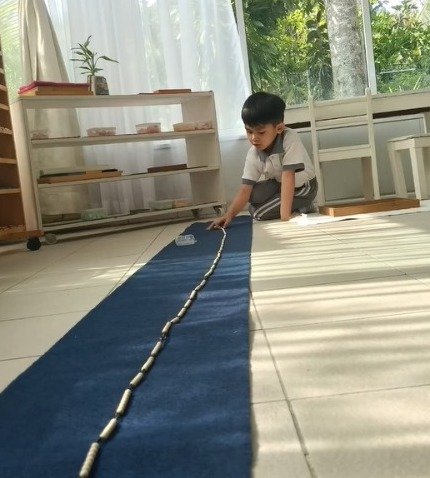
Watching a child work with the Montessori Long Chain is pure magic.
What looks like a line of beads is actually a fun way to learn skip counting and multiplication counting in 2s, 5s, 10s and seeing number patterns come alive!
As they count, repeat, and explore, children build confidence, focus, and a real understanding of how numbers grow.
Learning becomes a joyful journey… one bead at a time